The Owl of Dijon
Carved into a buttress of Notre-Dame Church, this small stone owl – which gave the street its name – is a symbol of reflection, knowledge, and foresight. It is a sign of good fortune. To make a wish, stroke it with your left hand, the side closest to your heart. The Black Cat and the Eagle Owl, made of polychrome earthenware and perched on the roof of the Maison Millière, are part of the wishing ritual just like the Salamander.

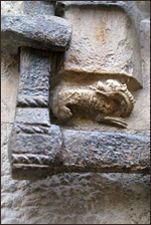
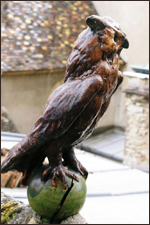
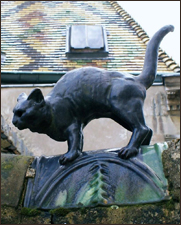
Rue de la Chouette and its secrets.
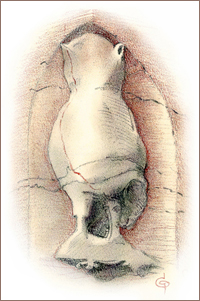
Rue de la Chouette is closely linked to the history of the owl, since, in the Middle Ages, it was called by the same name as today, referring to the small nocturnal bird of prey carved into the side of the church.
It was then renamed Rue Notre-Dame, no doubt at the instigation of parishioners eager to restore the supremacy of the cult of the Virgin Mary.
In 1904, with anticlericalism on the rise, the city council renamed the street once again, giving it a secular name deemed more appropriate for a public space.
There was hesitation over Eugène Pottier (a member of the Paris Commune and author of the lyrics to “The Internationale”), and ultimately, the alley became Rue Gracchus Babeuf, named after the revolutionary and inspiration behind communism.
In 1957, the street reclaimed its original name, restoring to the owl the patronage it so richly deserves.
Qui ne l’a caressée un jour ou l’autre de la main gauche en faisant un vœu, riant peut-être de ce rituel d’un autre âge, mais espérant au fond de lui-même qu’il se réalise ?
A beloved good-luck charm of the people of Dijon, the owl retains its air of familiar mystery.
Diverses hypothèses ont été avancées pour expliquer son origine, mais aucune n’a de fondement historique exact.
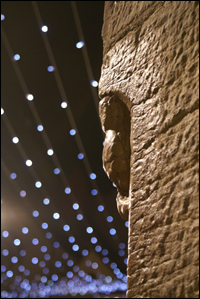
Some saw the owl as a personification of Christ, because he loved people “who are nothing but darkness.”
Others saw it as the talismanic symbol of Athena, the Greek goddess of wisdom, who is said to have accompanied the construction of Notre-Dame and guided the workers on the site
The Dijon historian Eugène Fyot, in the last century, simply believed that one of the master builders of Notre-Dame might have been named “Chouet” and that this was his signature. Similarly, in Vienne, in the Dauphiné region, a certain sculptor named Glaucus had signed his work with an owl carved on a cornice, by analogy with his name.
In any case, the little owl of Notre-Dame, weathered by the thousands of hands that have caressed it for centuries, remains a moving testament to the vitality of traditions and the attachment of a city’s and a neighborhood’s residents to its symbols.
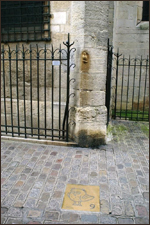 The Owl’s Trail
Discover the beauty and architectural richness of the City of the Grand Dukes of the West in 22 stages by following the owl’s trail, marked by small triangles bearing its image.
<=The Owl of April 1, 2011
On the morning of January 5, 2001, some idiot furiously struck it with a hammer about twenty times, tearing off the left side of its head and body. It has been repaired and remains the most touching and cherished symbol of Dijon.
The Maison Millière is located at No. 10, between the little lucky owl and the Hôtel de Voguë.

